Our Movement’s Manifesto: Improve Access to Health & Social Care
Our Movement’s Manifesto: Improve Access to Health & Social Care
Scotland will go to the polls on 7 May to elect a new Scottish Parliament in Edinburgh. What does the Community Transport movement need from our future MSPs and the next Scottish Government over the next five years?
Our Manifesto – Our Communities, Our Transport – sets out exactly that. And in a series of blogs in the run-up to polling day, I’ll break down our 9 policy asks of the political parties and their candidates as we seek to inform and influence their policies and positions.
Following my first blog, next up is the second of our 3 priorities – Improve Access to Health & Social Care.
This priority is all about ensuring that Community Transport is at the heart of our health & social care system, because we know how important accessible, affordable transport is for helping us all to lead longer, happier, healthier and more connected lives in our own homes.
We’re calling on MSPs and the next Scottish Government to Improve Access to Health & Social Care by:
1.Enforce the statutory duty on NHS Boards to work with Community Transport
Every single year, Community Transport operators across Scotland deliver more than half a million journeys to health- and social care-related destinations like hospitals, GP surgeries and day care centres.
By providing older people and disabled people with the tailored support they need, Community Transport is reducing pressure on social care, cutting NHS waiting lists and preventing delayed discharge. 39% of passengers tell us that they would be otherwise unable to travel.
And yet, these essential services are underfunded, undervalued and at risk of being lost. More than 1 in 4 operators tell us that they are not confident they will survive the next three years, not least due to growing demand and rising costs.
Our Manifesto features the voices of our amazing members, including Margaret Clowes, Service Manager at South West Community Transport (SWCT) in Glasgow, who were also the focus of our fantastic video.
Margaret says that demand for their services increased by 71% last year thanks to an ageing population and a shrinking Scottish Ambulance Service (which now delivers 64% fewer trips nationally than in 2017). However, despite their impact, “funding remains a major challenge” for SWCT “as many funders consider our work a statutory requirement”. Like 84% of CTA members, they do not receive any funding from their NHS Board or Health & Social Care Partnership for the essential health journeys they deliver.
We’re calling for the next Scottish Government to enforce the statutory duty of NHS Boards to work in partnership with Community Transport to deliver non-emergency patient transport services under the Transport (Scotland) Act 2019. We’ve made some progress by engaging directly with the boards, as well as convening the local sector to work together, but far too many people and communities are still waiting.
Our Making Scotland Healthier report revealed that NHS Boards across the country were failing to comply with their duties to work with local Community Transport operators to improve non-emergency patient transport. 12 out of 14 regional boards could not evidence full compliance with their legal requirements nearly six years after being passed into law.
Meanwhile, they had spent at least £21m over five years on taxis to fill the gaps, despite the fact that they were significantly worse for patients and significantly more expensive for taxpayers. Angie, who relies on Partnerships for Wellbeing in Inverness to get to cancer treatment, told us: “Commercial taxi drivers
are so impersonal – many of them do not speak – and don’t help you.”
2. Integrate transport into care packages
There are now more than 1 million people aged 65 and over in Scotland. With an ageing population come many challenges – not least, how to ensure every older person receives the social care they need.
In the last Parliament, the original proposals for a truly National Care Service represented one opportunity to redesign and improve the existing system, which is facing unprecedented pressures. However, this idea was ultimately watered down under widespread scrutiny.
There is still a need for a more joined-up, strategic approach which ensures health, social care and transport services are aligned, recognising that people have various interconnected needs.
We’re calling for the next Scottish Government to integrate accessible transport into holistic, person-centred care packages to enable people to live well for longer in their own homes.
3. Expand Community Transport within social prescribing
16% of CTA members in Scotland help to collect and deliver prescriptions, but the same proportion are also involved in social prescribing.
According to the Scottish Social Prescribing Network, social prescribing is a kind of community referral which enables health professionals like GPs, nurses and pharmacists to ‘refer people to a range of local, non-clinical services’.
It is an approach which recognises that everyone’s health and wellbeing is ‘determined mostly by a range of social, economic and environmental factors’ – and, therefore, may be more effectively improved with social opportunities and support, rather than through medical or pharmacological interventions.
Patients can be signposted to local community and voluntary organisations, such as befriending, healthy eating advice or sports. Community Transport can not only connect people with these activities and services, but it is also a critical enabler of more active and independent lives in its own right.
We’re calling for the next Scottish Government to expand the use of Community Transport within prevention and social prescribing to boost mental and physical health and wellbeing, tackle exclusion, isolation and loneliness and extend healthy life expectancy.
Be part of our movement for change
You can read my ‘Invest in Community Solutions’ blog here.
Click here to download our Manifesto for Scotland.
Click here to find out more about our campaign and how you can get involved.
If you’d like to discuss working together, feel free to email david.kelly@ctauk.org.
Share this article:
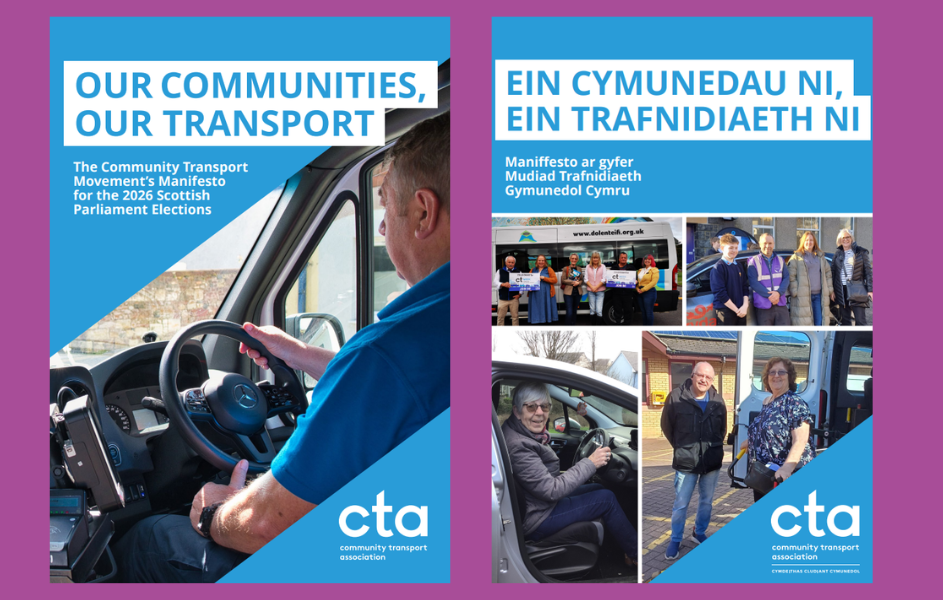
Our Manifestos for the 2026 Scottish and Welsh Elections
‘Our Communities, Our Transport’: Our Movement’s Manifesto for the 2026 Scottish and Welsh ElectionsVoters in Scotland and Wales go to the polls in May 2026 for devolved parliamentary elections.We believe that everyone in Scotland and Wales should have… Read more