
Community Transport: An essential link in Sharon's journey
A transport network is only accessible when every stage of the journey is accessible. For Sharon Gordon, the biggest barrier is not boarding a bus or train, but safely reaching the point where her journey starts.
Sharon is blind and lives in a rural area where the nearest bus stop is 1.2 miles from her home and the nearest train station is four miles away. With no continuous footpath, neither can be reached safely or independently. Although bus and rail services are available, they remain effectively inaccessible to Sharon without additional support.
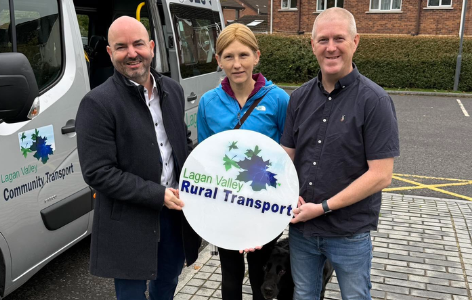
Connecting Sharon to the wider transport network
Before discovering Lagan Valley Rural Transport’s services through members of the local blind community, Sharon relied on family members for lifts or expensive taxis. Attending medical appointments, meeting up with friends and taking part in activities she enjoyed became far more difficult.
For the last nine years, community transport has provided the connection that enables Sharon to access the wider transport network. By connecting her safely to bus and rail services, it allows her to continue her journey independently and access opportunities that would otherwise be out of reach.
Support that builds confidence and independence
The support provided by drivers has also helped Sharon travel with greater confidence. Sharon describes LVRT’s drivers as always willing to go the extra mile and values the relationships she has built over the years with drivers and passengers. This personal connection is what sets community transport apart: it is a service built around people, not just a means to travel from A to B.
Community transport has enabled Sharon to maintain the active lifestyle she enjoyed before losing her sight. She can travel to essential healthcare appointments, meet friends, go to the gym and attend horse-riding sessions without depending on family members for lifts.
Why community transport matters
Sharon says that without LVRT’s service, her world “would be much smaller” and she would feel “very isolated and quite lonely”, because she is naturally a social person who enjoys being out and about.
Sharon hopes policymakers will recognise the profound impact community transport has on people’s lives. As she explains:
“MLAs need to understand how isolated people would be and how small and dark people's lives would be without community transport.”
An accessible and inclusive transport network must work for people like Sharon, wherever they live and whatever their transport needs. As Sharon’s story shows, community transport is not an optional extra.